
On Saturday August 29th, 2020 a group of activists in Montreal took it upon themselves to topple a statue of Canada’s first Prime Minister. They tore it down from its pedestal and as it crashed to the ground its head spun off to the cheers of onlookers. This action has since been lauded by other activists online and derided by those of a more conservative mindset.
The prevailing opinion by those who were aghast by the activists’ actions was that the act was an attempt to erase history. Much like opinions made on similar incidents in the United States, these people believe that statues such as Macdonald’s help retain history. By tearing them down, they argue, activists are trying to erase the past. It’s a ridiculous assertion.
As a certified teacher in Ontario (through K-12) and one who has specialized certifications in teaching History from the Intermediate to Senior grades (7-12) allow me to dispel this myth.
There are many public places that have Macdonald’s name emblazoned across them. From schools, to parkways, to pubs, all have leaned into the brand that is Macdonald. Yet, if you were to quiz anyone who frequents such places on Macdonald’s actual policies you’d like to get a lot of blank stares. After reading this entry, try it for yourself.
Today, The Globe and Mail, published an opinion piece by another Canadian History teacher, J.D.M. Stewart. In it, he states:
Critics of Macdonald act as though his regrettable actions against Indigenous peoples in the West were happening now. But his policies, which we rightly chafe against today, took place primarily in the 1880s. “Quite unlike Canadians of today,” wrote the late Richard Gwyn in his two-volume biography of one of this country’s greatest prime ministers, “nineteenth-century Canadians felt no guilt about their country’s treatment of Indians.”
Retrieved from: https://www.theglobeandmail.com/opinion/article-when-we-debate-complex-legacies-such-as-sir-john-as-we-must-not-be/?fbclid=IwAR2lmNbeuyCBj5tqFHVZV81w2q7f3_zP4ro_L3MHIKdqgGSp4I4-TS8xyus
It is with some regret I must correct the statements made by a fellow History teacher. Unfortunately, Macdonald’s actions are still echoing with us in the 21st century. Indigenous children continue to be seized by the state. Canada still chooses not to recognize Indigenous sovereignty and tramples on its own Treaty agreements. Canada has been condemned on the international stage for its treatment of Indigenous peoples and yet rather than feel shame, we continue to drag our feet to stave off any accountability when it comes to our colonialism.
Furthermore, unlike Stewart’s insinuation, Macdonald was very much criticized for his actions in his own time.
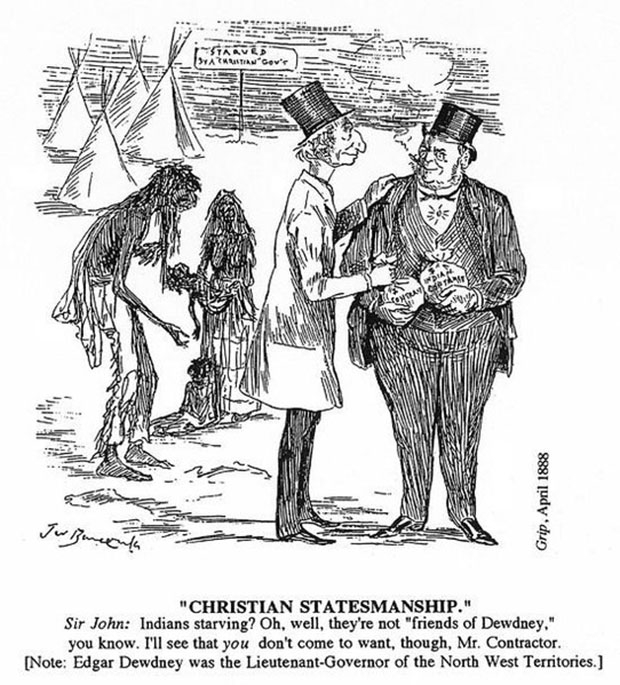
The above political cartoon was published in 1888. It is doesn’t tiptoe around its criticism of Macdonald’s policies when it came to his efforts to starve First Nations as a matter of government policy, in order to save money.
It is quite common for (white) Canadian historians to leave out contemporary opposition to Macdondald’s policy, as if everyone during that time were as racist as he. At this point History becomes less of an educational subject and more of a topic of propaganda, in that it glorifies mythological figures. Opposition within the House of Commons did indeed exist in the 19th century when it came to Macdonald.
Dr. Timothy Stanley, of the University of Ottawa’s Faculty of Education, wrote thusly:
Members of Parliament appeared to have been shocked by Macdonald’s
Journal of Critical Race Inquiry
final justification for Chinese disenfranchisement. Several members of the House, Matthew Hamilton Gault, Louis Henry Davies and Arthur Hill Gillmor challenged Macdonald’s amendment on the grounds that the Chinese were “industrious people” who had “voted in the last election” or who had “as good a right [to] be allowed to vote as any other British subject of foreign extraction” (Commons Debates, 1885, vol. xviii, p. 1585)
Volume 3, Number 1 (2016) pp. 6-34
Retrieved from: https://ojs.library.queensu.ca/index.php/CRI/article/view/5974/5934
When History teachers write that Macdonald was a product of his time, and voiced the prevailing attitudes of the time, they often overlook (either by ignorance- no excuse for a History teacher- or by choice) of those negatively impacted by Macdonald’s policies.
Stewart, in The Globe and Mail piece, argues:
It is ahistorical to take Macdonald out of his times and thrust our causes and our fights for justice onto him. “Macdonald has been unfairly abused for being a man of the 19th century,” University of Toronto historian Robert Bothwell told Maclean’s magazine in 2016. “He had moral failings, and was sometimes indifferent to or negligent of serious problems. He did not have our sensibilities, and had many of the characteristics of his period that at the time passed without comment because they were so widely held.”
Retrieved from: https://www.theglobeandmail.com/opinion/article-when-we-debate-complex-legacies-such-as-sir-john-as-we-must-not-be/?fbclid=IwAR2lmNbeuyCBj5tqFHVZV81w2q7f3_zP4ro_L3MHIKdqgGSp4I4-TS8xyus
So widely held by whom? The majority of white Canadians? Why are their voices championed over Chinese immigrants? Why do Historians, and my fellow History teachers, continue to erase the experiences of Indigenous peoples who assuredly did not want to be ethnically cleansed from the land to make way for white settlers? Sure, many (white) power holders at that time did not want fair and equitable treatment of racialized people, a sentiment echoed today 150+ years later. Why is it by their views we cannot judge Macdonald? We have no problem saying Hitler was a monster for what he did, even if many white, straight, able bodied and cis Germans at the time had no problems with him. When it comes to other countries’ history, we examine how these leaders impacted the lives of victims and survivors, and yet we suspend that analysis when it comes to our own.
Critics will say that we cannot levy charges of genocide against Macdonald because such vocabulary didn’t exist at the time. The word “murder” certainly did and I fail to see how it cannot be used against a man who willfully starved people to clear the land. Macdonald himself was quite capable of recognizing murder, and making light of it.
A curious remark was once made by Sir John at the railway station at Hamilton, and whether it was a serious statement of his belief or an unappreciated stroke of humor is not known to this day. Some friends were talking of a murder that had occurred. When the case was tried there was doubt as to the prisoner’s guilt, when he remarked that in a case of murder it was better that an innocent man should be hanged than no man at all.
Anecdotal Life of Sir John Macdonald
By E.B. Biggar
1881
Perhaps the white gatekeepers at the time didn’t view the deaths of Indigenous people as murder but we do know that Indigenous people at the time were very much against Macdonald’s murderous cruelty, as is evidenced by acts of resistance and rebellion. Erasure of such experiences have led to these perspectives not being taught in school and the general public being unaware of them (thereby propagating the mythological aspects of politicians like Macdonald rather than the historical reality).
Louis Riel, at his trial in 1885 stated:
When I came into the North West in July, the first of July 1884, I found the Indians suffering. I found the half-breeds eating the rotten pork of the Hudson Bay Company and getting sick and weak every day. Although a half breed, and having no pretension to help the whites, I also paid attention to them. I saw they were deprived of responsible government, I saw that they were deprived of their public liberties. I remembered that half-breed meant white and Indian, and while I paid attention to the suffering Indians and the half-breeds I remembered that the greatest part of my heart and blood was white and I have directed my attention to help the Indians, to help the half-breeds and to help the whites to the best of my ability. We have made petitions, I have made petitions with others to the Canadian Government asking to relieve the condition of this country. We have taken time; we have tried to unite all classes, even if I may speak, all parties. Those who have been in close communication with me know I have suffered, that I have waited for months to bring some of the people of the Saskatchewan to an understanding of certain important points in our petition to the Canadian Government and I have done my duty.
Retrieved from: http://law2.umkc.edu/faculty/projects/ftrials/riel/rieltrialstatement.html
Statues, such as the one toppled in Montreal, do very little in educating the public, despite being on public land. Stewart argues these statues in Canada don’t function the same as Confederate statues in the US, as they aren’t meant to intimidate an oppressed segment of the population:
The real historical vandalism is not so much the destruction of public property, but in the singular and contemporary lens with which people are trying to judge actors from the past such as Macdonald. Unlike statues of Confederate “heroes” in the United States, which were raised in homage to the South’s support for slavery and to remind people of it, the statues of Macdonald were not put up in celebration of his genuine and ugly mistakes but for his larger legacy: his undeniable contribution to creating the Dominion of Canada.
Retrieved from: https://www.theglobeandmail.com/opinion/article-when-we-debate-complex-legacies-such-as-sir-john-as-we-must-not-be/?fbclid=IwAR2lmNbeuyCBj5tqFHVZV81w2q7f3_zP4ro_L3MHIKdqgGSp4I4-TS8xyus
This is a lazily-made argument as the creation of the Dominion of Canada was only possible by acts of genocide against Indigenous peoples. Most of these statues (if not all) are placed on stolen, unceded, territory, and as such are there to remind people of who holds power in this country and why. Celebrating the creation of “Canada” is in itself a reminder to Indigenous people what they have lost, and continue to lose. I’m not quite sure why History teachers, like Stewart, are incapable of recognizing this.
Macdonald was a strong proponent of creating an Aryan state and upholding other white supremacist ideals. As noted in Dr. Stanley’s quotes of Macdonald concerning Chinese immigrants:
…if they came in great numbers and settled on the Pacific coast they might control the vote of that whole Province, and they would send Chinese representatives to sit here, who would represent Chinese eccentricities, Chinese immorality, Asiatic principles altogether opposite to our wishes; and, in the even balance of parties, they might enforce those Asiatic principles, those immoralities … the eccentricities which are abhorrent to the Aryan race and Aryan principles, on this House. (1885, vol. xviii, p. 1588)
[…]
The truth is, that all natural history, all ethnology, shows that, while the crosses of the Aryan races are successful-while a mixture of all those races which are known or believed to spring from a common origin is more or less successful-they will amalgamate. If you look around the world you will see that the Aryan races will not wholesomely amalgamate with the Africans or the Asiatics. It is not to be desired that they should come; that we should have a mongrel race, that the Aryan character of the future of British America should be destroyed by a cross or crosses of that kind. (Commons Debates, 1885, vol. xviii, p. 1589)
Journal of Critical Race Inquiry
Volume 3, Number 1 (2016) pp. 6-34
Retrieved from: https://ojs.library.queensu.ca/index.php/CRI/article/view/5974/5934
It’s quite clear from Macdonald’s own words that he viewed himself as a white (or aryan) supremacist, and wanted Canada to be a country built upon those ideals. Is there currently a statue of his in a public place that teaches people these facts, or are the statues instead a glorification of someone wanting to create an Aryan state?
An important link that is also not taught by these statues is how Macdonald enthusiastically spoke in defence of the pro-slavery South in the US Civil War.
I believe we shall have at length an organization that will enable us to be a nation and protect ourselves as we should. Look at the gallant defence that is being made by the Southern Republic – at this moment they have not much more than four millions of men – not much exceeding our own numbers – yet what a brave fight they have made, notwithstanding the stern bravery of the New Englander, or the fierce elan of the Irishman. (Cheers.)
SPEECH BY JOHN A. MACDONALD – TOAST TO COLONIAL UNION, HALIFAX, SEPTEMBER 12, 1864
Retrieved from: https://www.macdonaldlaurier.ca/speech-by-john-a-macdonald-toast-to-colonial-union-halifax-september-12-1864/
In another instance:
When the American Civil War broke out, Mr. Macdonald was of opinion that it would result in the formation of two nations. In a speech in 1861 he said : ” He agreed with every word of regret that had been expressed at the unhappy and lamentable state of things which they now witnessed in the States, for he remembered they were of the same blood as ourselves. He still looked hopefully to the future of the United States. He believed there was a vigor, a vitality in the Anglo-Saxon character and institutions of the States that would carry them through this great convulsion, as they had carried through our mother country in days of old. He hoped that if they were to be severed in two—as severed in two he believed they would be— two great, two noble, two free nations would exist in place of one.”
Anecdotal Life of Sir John Macdonald
By E.B. Biggar
1881
Here Historians and History teachers have much less wiggle room. Macdonald champions and welcomes a sovereign state borne out of slavery. It is very telling who he expects to be free in this state (those of an Anglo-Saxon character). I’m sure there will be someone reading this ready to make an argument that the South really wasn’t fighting to protect slavery, but I’ll head that off by linking to the Confederate vice president, Alexander H. Stephens’ Cornerstone speech:
Our new government is founded upon exactly the opposite idea; its foundations are laid, its corner-stone rests, upon the great truth that the negro is not equal to the white man; that slavery subordination to the superior race is his natural and normal condition. This, our new government, is the first, in the history of the world, based upon this great physical, philosophical, and moral truth.
Retrieved from: https://teachingamericanhistory.org/library/document/cornerstone-speech/
It is worth noting that Macdonald’s wife, Agnes Bernard, was the daughter of a slave and plantation-owner in Jamaica. Her father, Thomas James Bernard, ran a sugar plantation in Jamaica and owned 96 slaves. As slavery was abolished throughout the British Empire, he received special compensation, amounting to £1723 (approximately 30 times the annual salary of a skilled worker in those times).
Biographer, E.B. Biggar in 1881 noted:
While still a mere child, Miss Agnes Bernard lost her father, and—as about the same time the family property became seriously diminished in value by the introduction of free-trade, following upon the abolition of slavery—her mother decided to remove to England. ” At first the change of environment proved very unwelcome. The difference of atmosphere between Jamaica—where the lower classes were all attention and servility—and England— where even the servants had wills of their own and dared to show them—was not to be comprehended at once.” But the years, busy with books and acquiring accomplishments, slipped by, and England, despite her exclusiveness, became very dear. In the meantime, matters in Jamaica were going from bad to worse. The planters fell into the depths of ruin, and all who could get away from the ill-fated island with any remnants of their fortunes, hastened to do so.
Anecdotal Life of Sir John Macdonald
By E.B. Biggar
1881
As has been made clear, there is an overwhelming amount of evidence against honouring Macdonald in the fashion many Canadians do. Historians and History teachers who purposefully sidestep all these historical footnotes should probably consider calling themselves something different. If you are going to make an argument that Macdonald was a product of his time, and we should restrain ourselves from criticising him with 21st century norms, you really need to ask yourself why you choose to to defend a white supremacist. There was ample criticism against Macdonald in the 19th century and he faced it in the press and in the House of Commons. Historians who choose to ignore this are making the choice to erase voices. Removing problematic statues recentres the conversation these Historians don’t want to have; they are less interested in preserving history than promoting national mythological narratives.
 Haligowan
You must be logged in to post a comment.