Seeing liberal usage of the word “Nazi” thrown around in online discourse used to cause me to roll my eyes. My understanding at the time was that it was a hyperbolic charge undermining the fatal effects of Nazism. I felt invoking the word cheapened it with each use when there were more specific insults one could levy. Understandings evolve.
The mistake I made was thinking Nazism was an artifact delegated to the past and not one contributing to echoes and repeating patterns. As I further researched far-right groups (first as a curiosity for a sociology assignment, then more seriously) I realized these groups were really borrowing from a playbook Nazis popularized.
Nazism and Nazis never went away.
Groomer/Predator/Pedo
One of the most common epithets you see hurled online towards anyone daring to stand up for 2SLGBTQIA+ rights. Search my handle on Twitter and include any of the above three; you’ll be flooded with results. It’s in vogue now but the Nazis used the exact same phrasing to pass stigmatizing laws against the LGBT community of Germany at the time. These arguments would spread in the US following the Second World War. Coincidentally, so would Nazis.
Banning and Burning Books
Of course, if you’ve watched Indiana Jones and The Last Crusade, you’ve seen re-enactments of Nazis burning books. We’ve seen many examples of hate influencer accounts on Twitter gang up and pounce on elementary teachers here in Ontario for simply having queer friendly books in their classroom. If a teacher even mentions, or someone leaks a photo of their classroom, that they have a book about a child transitioning, these transphobic influencer accounts unleash torrents of abuse.
If you guessed I was going to link this behaviour to Nazis in the 1930s you’re catching on. 90 years ago, a revolutionary clinic was raided and the wealth of information it contained was razed. This attempt to erase people from history leads to the misinformed thinking that trans kids pop out from the ground and haven’t always been with us.
Antisemitism
Most know that Nazis are antisemitic. The problem is that most can’t identify antisemitism in discourse spread by the far-right today. There are a bunch of tropes they use casually. A shadowy cabal of powerful people controlling world politics? Yeah, that garbage has been with us for a while. Mentions of The Great Reset or those including the World Economic Forum (usually shortened to ‘WEF’)? It’s the same kind of garbage.
Once your eye is trained to notice these things, you’ll find that a lot of these transphobes also peddle in antisemitic conspiracy theories. The signs are all there but unless you are taught these things, chances are you won’t seek them out on their own. But when people of a certain political strip are hellbent to prevent that from happening, it’s because they want history to repeat itself.
Cracking Down on Rainbow Clubs and GSAs
There is a strong parallel between this sudden vitriolic increase in wanting to shut down rainbow clubs/GSAs in schools and gay associations in Germany as the Nazis rose to power. In Ottawa, we’ve seen protests at schools with rainbow clubs trying to shut them down or largescale walkouts for Pride activities as benign as raising a flag.
The Nazis weren’t happy with LGBT+ people congregating and having associations, either. In fact, they went out of their way to dismantle them with brute force.
Conservative parties in Canada are tripping over themselves to tap into queer and transphobia by outing students. This haste to either keep kids in the closet or have them go through a bureaucratic process to identify them should sound familiar to anyone who knows the history of the pink triangle.
Learn to Take a Joke/They’re Just Trolls
A common retort whenever a hate influencer gets called on their violence is that they weren’t actually being serious. They were just joking when they made that threat on a live stream. Those of us taking note need to lighten up.
But if you know how violent white supremacists have always gotten their message it out, it’s through allegedly “edgy” humour. Hitler did the same thing decades before taking power. Go on any journalist’s account when she’s documenting far-right violence. Read the creepy comments not as jokes but as threats. The goal is always to intimidate and silence. A pattern emerges for whom these comments are directed towards.
How Can They Be Homophobic/Transphobic/______ When They Associate with ________?
I was going to use the variable x instead of blanks in the above heading but then remembered Twitter has been renamed and it might throw people off.
But I digress.
One of the laziest ways for the far-right to try and escape criticism is to prop up a model member from a minority group they usually persecute. Can they really be anti-Black if they have this Black person espousing their views? Can they really be homophobic if they have this lesbian agreeing with their points on their podcast?
This is playing out in the current anti-trans panic with people claiming to be gay or lesbian fighting against the word “queer” or openly questioning the inclusion of transgender folks in the larger 2SLGBTQIA+ community. We’ve seen examples of the far-right in Canada finding a trans person they can parade around and claim their violence isn’t really all that violent. Or a queer school board trustee candidate, surrounded by open homophobes, who campaigns against the human rights of 2SLGBTQIA+ students.
In Summary
When you encounter someone who regularly espouses any of the above views, treat them as you would a Nazi. Don’t debate them. They aren’t interested in having their mind changed. They want to waste your time and at the very least harm your mental health. Don’t uncritically boost their garbage to your audience.
You don’t need to play any respectability politics game with them. Respectable people don’t parrot Nazi talking points. Take note of when the account was created. Check who follows them. Check who they follow. Block as many of them as you can to protect yourself from the next online swarm (guess who else attacked others through mobs?).
With Twitter continuing to implode, it might be wise to look for other opportunities on different socials. It is incredibly hard to rebuild online communities once they migrate to other apps. With that in mind, here’s where you can currently find “me”:
I’ll continue using Twitter for the foreseeable future. It remains useful on desktop when you have this extension running. Unfortunately, the app experience is getting worse as there’s no way to counter Musk’s destructive tweaking of the platform.
When the majority of my mutuals pick a clear winner from the above I’ll abandon Twitter. Whether or not this happens before Musk sells it or completely grinds it into dust remains unknown. With education unions gearing up for possible strike actions in Ontario I hope this disruption won’t affect our ability to be nimble and network with each other.
At the end of the last week, Twitter suspended my account for a response I sent to an intentionally transphobic reply to me. With such an explosive opening statement I wouldn’t be surprised if you thought my jailable offence was for something spicy. No doubt you are champing at the bit waiting for me to divulge all the juicy details (if your eyes haven’t already scanned below).
Unfortunately, the infraction is a bit of a letdown. The statement that instantly resulted in a 12-hour suspension after pressing send was:
If you’re scratching your head at how such a statement could result in a suspension, Twitter instantly provided its reasoning:
Specifically for: Violating our rules against promoting or encouraging suicide or self-harm. You may not promote or encourage suicide or self-harm. When we receive reports that a person is threatening suicide or self-harm, we may take a number of steps to assist them, such as reaching out to that person and providing resources such as contact information for our mental health partners.
Twitter
It happened instantly after sending the tweet so I could only guess that it was an automatic action taken by the system, and that someone decided to code “go jump into a lake” as “self-harm”. I am not sure what dictionary they were using for that judgement call but it’s not one I’ve read.
I was bemused to be suspended for something so innocuous when my mentions are frequently clogged with Nazi imagery, libelous accusations, queer and transphobic comments, genocide denial, and the occasional death threat. Not once have I ever received a notification that a violent reply sent to me violated Twitter’s TOS. I’ve reported so many tweets over the years, and no matter how blatant the bigotry, they almost always escape suspension. This includes accounts whose handles are antisemitic or include a profile picture that is literal blackface.
The civility trap seems to apply to people on the receiving end of abuse and not enforced for the bucketload of obviously fake accounts doling out violent bigotry. All you need to do is search Twitter for my handle and a few choice slurs to see your results quickly fill up.
At some point, over a decade ago, social media became my chief news outlet. Twitter was great for this as I would see stories pushed onto my feed I wouldn’t have otherwise seen. Alas, all good things must come to an end and Twitter is definitely coming to some sort of tumultuous end.
The guy who bought it regularly boosts violent people and engages in horrible behaviour in some kind of bid to remain relevant. People who were kicked off the platform are now being welcomed back so they can freely engage in the atrocities that got them kicked off in the first place.
I’ve seen a lot of the accounts I follow openly question how much longer they can remain on a compromised platform. Each social media enclave has its unique atmosphere, and the allure of Twitter meant it brought in many people under a social justice umbrella. Being able to microblog quick snippets to a wider audience was a fast way to get pertinent information out.
My first foray was to surround myself with other creatives at the time and treat it like an alternative Facebook. Eventually, I was drawn to the public commons aspect of the site. The Idle No More movement played a large part in this as I was able to get information from within the movement without the lens of established media washing away all nuances. Finding and following activists on the ground in Ferguson, and seeing real time abuses on Wet’suwet’en land by the RCMP
Conspiracy theorists always existed on the website, as well as racists, misogynists, homophobes, and every other sort of deplorable. Nascent hate movements like Gamergate and Comicsgate preyed on impressionable, often male, users and were an introduction of sorts to what we see all over the platform in 2023. They laid the groundwork for the massive swell of swarming by hate influencers. The bleating of “actually it’s about ethics in gaming journalism” ran as hollow then as “actually it’s about protecting kids from grooming” does today.
At this point there doesn’t seem to be a viable alternative to Twitter, which is why many of us continue to stick around, despite the abuse. The constant firing of important company staff members seems to contribute to an untold number of glitches. I still use it to get important community updates I would otherwise miss if I only followed traditional news sources. However, the sense of “community” is quickly dissipating (my big conspiracy theory is that it’s intentional due to who bought it). Replies from friends don’t always show up as a notification, even though abusive replies will pop up without delay. Friends and many of the people I follow take frequent breaks from the app, for their mental health, as they experience nonstop abusive harassment and swarmings.
There was a push to get people on Mastadon and that fizzled. TikTok is fairly labour intensive by comparison. Instagram, being owned by Meta, has many of Facebook’s problems (being awash with ads and finding it difficult to see your friends’ posts in order). Maybe we need to bring back RSS feeds, cut out the “micro” part of micro-blogging and have everyone go back to using blogs. At least then we would limit Twitter-style pile ons and produce content that benefits us, rather than providing advertisement space for an immature billionaire.
The prevailing opinion by those who were aghast by the activists’ actions was that the act was an attempt to erase history. Much like opinions made on similar incidents in the United States, these people believe that statues such as Macdonald’s help retain history. By tearing them down, they argue, activists are trying to erase the past. It’s a ridiculous assertion.
As a certified teacher in Ontario (through K-12) and one who has specialized certifications in teaching History from the Intermediate to Senior grades (7-12) allow me to dispel this myth.
There are many public places that have Macdonald’s name emblazoned across them. From schools, to parkways, to pubs, all have leaned into the brand that is Macdonald. Yet, if you were to quiz anyone who frequents such places on Macdonald’s actual policies you’d like to get a lot of blank stares. After reading this entry, try it for yourself.
Today, The Globe and Mail, published an opinion piece by another Canadian History teacher, J.D.M. Stewart. In it, he states:
Critics of Macdonald act as though his regrettable actions against Indigenous peoples in the West were happening now. But his policies, which we rightly chafe against today, took place primarily in the 1880s. “Quite unlike Canadians of today,” wrote the late Richard Gwyn in his two-volume biography of one of this country’s greatest prime ministers, “nineteenth-century Canadians felt no guilt about their country’s treatment of Indians.”
It is quite common for (white) Canadian historians to leave out contemporary opposition to Macdondald’s policy, as if everyone during that time were as racist as he. At this point History becomes less of an educational subject and more of a topic of propaganda, in that it glorifies mythological figures. Opposition within the House of Commons did indeed exist in the 19th century when it came to Macdonald.
Dr. Timothy Stanley, of the University of Ottawa’s Faculty of Education, wrote thusly:
Members of Parliament appeared to have been shocked by Macdonald’s final justification for Chinese disenfranchisement. Several members of the House, Matthew Hamilton Gault, Louis Henry Davies and Arthur Hill Gillmor challenged Macdonald’s amendment on the grounds that the Chinese were “industrious people” who had “voted in the last election” or who had “as good a right [to] be allowed to vote as any other British subject of foreign extraction” (Commons Debates, 1885, vol. xviii, p. 1585)
When History teachers write that Macdonald was a product of his time, and voiced the prevailing attitudes of the time, they often overlook (either by ignorance- no excuse for a History teacher- or by choice) of those negatively impacted by Macdonald’s policies.
Stewart, in The Globe and Mail piece, argues:
It is ahistorical to take Macdonald out of his times and thrust our causes and our fights for justice onto him. “Macdonald has been unfairly abused for being a man of the 19th century,” University of Toronto historian Robert Bothwell told Maclean’s magazine in 2016. “He had moral failings, and was sometimes indifferent to or negligent of serious problems. He did not have our sensibilities, and had many of the characteristics of his period that at the time passed without comment because they were so widely held.”
So widely held by whom? The majority of white Canadians? Why are their voices championed over Chinese immigrants? Why do Historians, and my fellow History teachers, continue to erase the experiences of Indigenous peoples who assuredly did not want to be ethnically cleansed from the land to make way for white settlers? Sure, many (white) power holders at that time did not want fair and equitable treatment of racialized people, a sentiment echoed today 150+ years later. Why is it by their views we cannot judge Macdonald? We have no problem saying Hitler was a monster for what he did, even if many white, straight, able bodied and cis Germans at the time had no problems with him. When it comes to other countries’ history, we examine how these leaders impacted the lives of victims and survivors, and yet we suspend that analysis when it comes to our own.
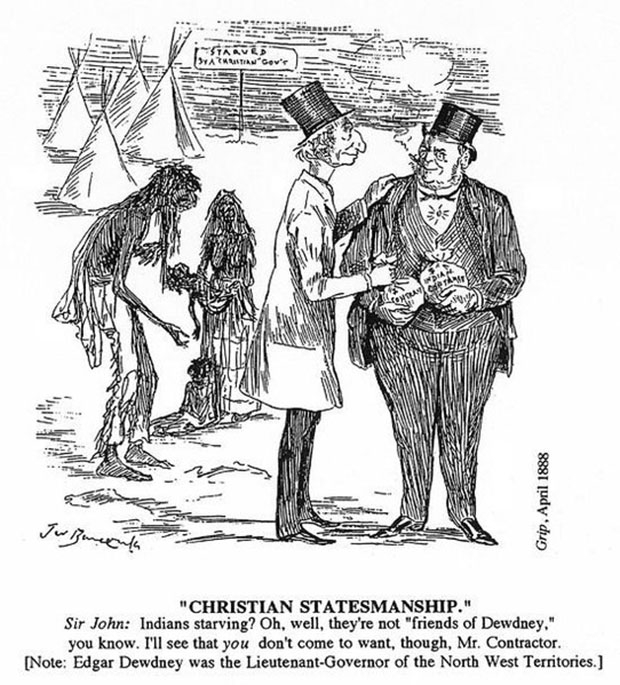
Critics will say that we cannot levy charges of genocide against Macdonald because such vocabulary didn’t exist at the time. The word “murder” certainly did and I fail to see how it cannot be used against a man who willfully starved people to clear the land. Macdonald himself was quite capable of recognizing murder, and making light of it.
A curious remark was once made by Sir John at the railway station at Hamilton, and whether it was a serious statement of his belief or an unappreciated stroke of humor is not known to this day. Some friends were talking of a murder that had occurred. When the case was tried there was doubt as to the prisoner’s guilt, when he remarked that in a case of murder it was better that an innocent man should be hanged than no man at all.
Anecdotal Life of Sir John Macdonald By E.B. Biggar 1881
Perhaps the white gatekeepers at the time didn’t view the deaths of Indigenous people as murder but we do know that Indigenous people at the time were very much against Macdonald’s murderous cruelty, as is evidenced by acts of resistance and rebellion. Erasure of such experiences have led to these perspectives not being taught in school and the general public being unaware of them (thereby propagating the mythological aspects of politicians like Macdonald rather than the historical reality).
Louis Riel, at his trial in 1885 stated:
When I came into the North West in July, the first of July 1884, I found the Indians suffering. I found the half-breeds eating the rotten pork of the Hudson Bay Company and getting sick and weak every day. Although a half breed, and having no pretension to help the whites, I also paid attention to them. I saw they were deprived of responsible government, I saw that they were deprived of their public liberties. I remembered that half-breed meant white and Indian, and while I paid attention to the suffering Indians and the half-breeds I remembered that the greatest part of my heart and blood was white and I have directed my attention to help the Indians, to help the half-breeds and to help the whites to the best of my ability. We have made petitions, I have made petitions with others to the Canadian Government asking to relieve the condition of this country. We have taken time; we have tried to unite all classes, even if I may speak, all parties. Those who have been in close communication with me know I have suffered, that I have waited for months to bring some of the people of the Saskatchewan to an understanding of certain important points in our petition to the Canadian Government and I have done my duty.
Statues, such as the one toppled in Montreal, do very little in educating the public, despite being on public land. Stewart argues these statues in Canada don’t function the same as Confederate statues in the US, as they aren’t meant to intimidate an oppressed segment of the population:
The real historical vandalism is not so much the destruction of public property, but in the singular and contemporary lens with which people are trying to judge actors from the past such as Macdonald. Unlike statues of Confederate “heroes” in the United States, which were raised in homage to the South’s support for slavery and to remind people of it, the statues of Macdonald were not put up in celebration of his genuine and ugly mistakes but for his larger legacy: his undeniable contribution to creating the Dominion of Canada.
This is a lazily-made argument as the creation of the Dominion of Canada was only possible by acts of genocide against Indigenous peoples. Most of these statues (if not all) are placed on stolen, unceded, territory, and as such are there to remind people of who holds power in this country and why. Celebrating the creation of “Canada” is in itself a reminder to Indigenous people what they have lost, and continue to lose. I’m not quite sure why History teachers, like Stewart, are incapable of recognizing this.
Macdonald was a strong proponent of creating an Aryan state and upholding other white supremacist ideals. As noted in Dr. Stanley’s quotes of Macdonald concerning Chinese immigrants:
…if they came in great numbers and settled on the Pacific coast they might control the vote of that whole Province, and they would send Chinese representatives to sit here, who would represent Chinese eccentricities, Chinese immorality, Asiatic principles altogether opposite to our wishes; and, in the even balance of parties, they might enforce those Asiatic principles, those immoralities … the eccentricities which are abhorrent to the Aryan race and Aryan principles, on this House. (1885, vol. xviii, p. 1588)
[…]
The truth is, that all natural history, all ethnology, shows that, while the crosses of the Aryan races are successful-while a mixture of all those races which are known or believed to spring from a common origin is more or less successful-they will amalgamate. If you look around the world you will see that the Aryan races will not wholesomely amalgamate with the Africans or the Asiatics. It is not to be desired that they should come; that we should have a mongrel race, that the Aryan character of the future of British America should be destroyed by a cross or crosses of that kind. (Commons Debates, 1885, vol. xviii, p. 1589)
It’s quite clear from Macdonald’s own words that he viewed himself as a white (or aryan) supremacist, and wanted Canada to be a country built upon those ideals. Is there currently a statue of his in a public place that teaches people these facts, or are the statues instead a glorification of someone wanting to create an Aryan state?
An important link that is also not taught by these statues is how Macdonald enthusiastically spoke in defence of the pro-slavery South in the US Civil War.
I believe we shall have at length an organization that will enable us to be a nation and protect ourselves as we should. Look at the gallant defence that is being made by the Southern Republic – at this moment they have not much more than four millions of men – not much exceeding our own numbers – yet what a brave fight they have made, notwithstanding the stern bravery of the New Englander, or the fierce elan of the Irishman. (Cheers.)
When the American Civil War broke out, Mr. Macdonald was of opinion that it would result in the formation of two nations. In a speech in 1861 he said : ” He agreed with every word of regret that had been expressed at the unhappy and lamentable state of things which they now witnessed in the States, for he remembered they were of the same blood as ourselves. He still looked hopefully to the future of the United States. He believed there was a vigor, a vitality in the Anglo-Saxon character and institutions of the States that would carry them through this great convulsion, as they had carried through our mother country in days of old. He hoped that if they were to be severed in two—as severed in two he believed they would be— two great, two noble, two free nations would exist in place of one.”
Anecdotal Life of Sir John Macdonald By E.B. Biggar 1881
Here Historians and History teachers have much less wiggle room. Macdonald champions and welcomes a sovereign state borne out of slavery. It is very telling who he expects to be free in this state (those of an Anglo-Saxon character). I’m sure there will be someone reading this ready to make an argument that the South really wasn’t fighting to protect slavery, but I’ll head that off by linking to the Confederate vice president, Alexander H. Stephens’ Cornerstone speech:
Our new government is founded upon exactly the opposite idea; its foundations are laid, its corner-stone rests, upon the great truth that the negro is not equal to the white man; that slavery subordination to the superior race is his natural and normal condition. This, our new government, is the first, in the history of the world, based upon this great physical, philosophical, and moral truth.
It is worth noting that Macdonald’s wife, Agnes Bernard, was the daughter of a slave and plantation-owner in Jamaica. Her father, Thomas James Bernard, ran a sugar plantation in Jamaica and owned 96 slaves. As slavery was abolished throughout the British Empire, he received special compensation, amounting to £1723 (approximately 30 times the annual salary of a skilled worker in those times).
Biographer, E.B. Biggar in 1881 noted:
While still a mere child, Miss Agnes Bernard lost her father, and—as about the same time the family property became seriously diminished in value by the introduction of free-trade, following upon the abolition of slavery—her mother decided to remove to England. ” At first the change of environment proved very unwelcome. The difference of atmosphere between Jamaica—where the lower classes were all attention and servility—and England— where even the servants had wills of their own and dared to show them—was not to be comprehended at once.” But the years, busy with books and acquiring accomplishments, slipped by, and England, despite her exclusiveness, became very dear. In the meantime, matters in Jamaica were going from bad to worse. The planters fell into the depths of ruin, and all who could get away from the ill-fated island with any remnants of their fortunes, hastened to do so.
Anecdotal Life of Sir John Macdonald By E.B. Biggar 1881
As has been made clear, there is an overwhelming amount of evidence against honouring Macdonald in the fashion many Canadians do. Historians and History teachers who purposefully sidestep all these historical footnotes should probably consider calling themselves something different. If you are going to make an argument that Macdonald was a product of his time, and we should restrain ourselves from criticising him with 21st century norms, you really need to ask yourself why you choose to to defend a white supremacist. There was ample criticism against Macdonald in the 19th century and he faced it in the press and in the House of Commons. Historians who choose to ignore this are making the choice to erase voices. Removing problematic statues recentres the conversation these Historians don’t want to have; they are less interested in preserving history than promoting national mythological narratives.


 Haligowan
You must be logged in to post a comment.